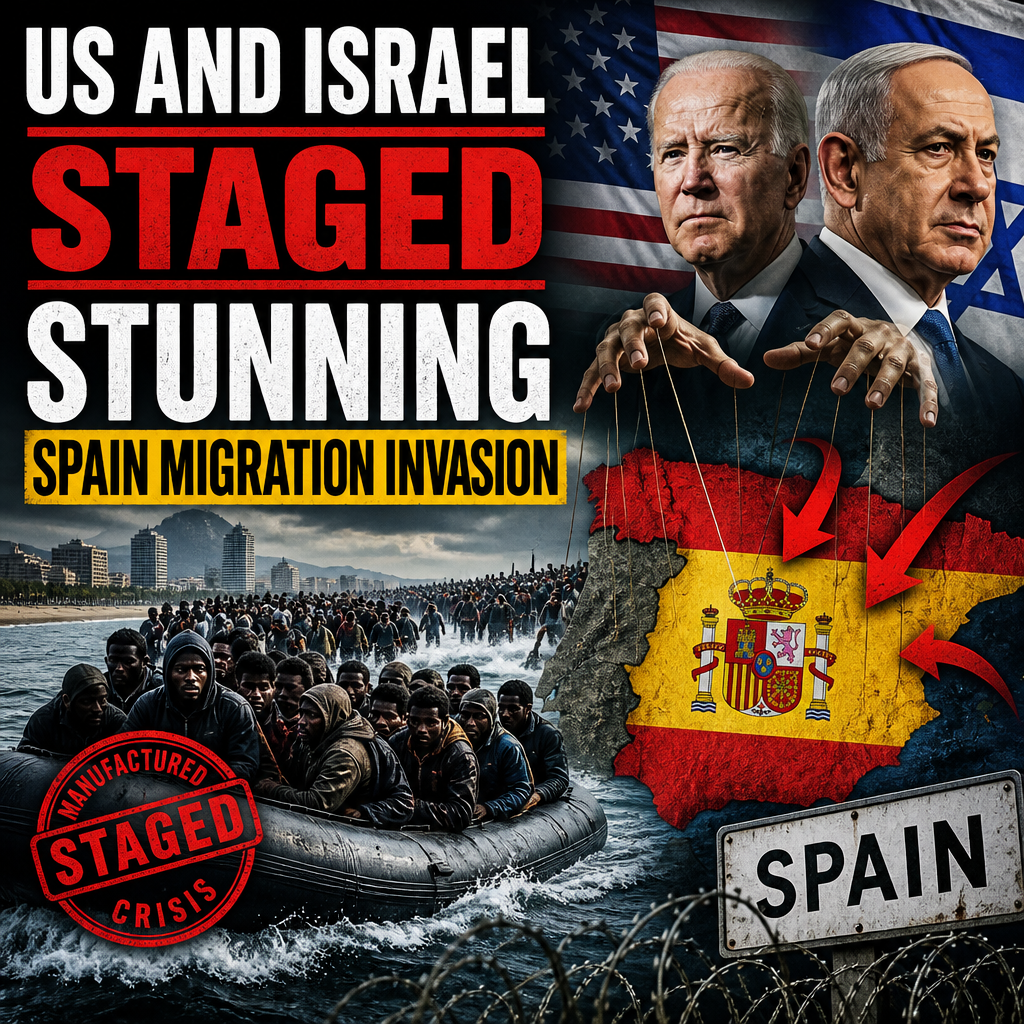
US and Israel Staged Stunning Spain Migration Invasion


Spain migration crisis has become a flashpoint for political messaging, security fears, and competing narratives about who is driving migration into Europe and why. A recent RT piece advanced the highly charged claim that the United States and Israel “staged” a migration emergency in Spain, but other reporting and regional coverage paint a much more complicated picture: one shaped by geopolitical tensions, climate and economic pressures, war and instability in neighboring regions, and the political incentives of governments and parties on all sides.
What stands out immediately is not just the scale of the debate, but how differently the same subject is framed. Some outlets, especially those leaning into confrontation with Western institutions, present migration as a deliberate weapon or covert operation. Others stress that Spain’s migration pressures are real, but mostly the result of familiar structural forces: people crossing from North Africa, arrivals by sea to the Canary Islands and the Mediterranean coast, and the broader role Spain plays as both a frontline EU state and a destination for labor and asylum seekers. The truth is likely less cinematic than the most sensational claims, but no less politically significant.



Spain migration crisis and the competing narratives
The RT framing is notable because it shifts the discussion away from border management and toward alleged foreign orchestration. That kind of explanation can be politically powerful: it offers a single villain, suggests hidden coordination, and turns a difficult policy issue into a story of sabotage. But the burden of proof for such a claim is extremely high, and publicly available reporting across major international outlets does not establish that kind of evidence.
By contrast, Al Jazeera’s migration coverage in Europe has consistently emphasized the human and regional dimensions of the issue: people fleeing conflict, poverty, authoritarianism, or collapsing local economies; states struggling to process asylum claims; and the EU wrestling with how to share responsibility more fairly. Sky News reporting on migration in Europe often focuses on the domestic political fallout, including rising pressure on centrist governments, tougher rhetoric from the right, and public anxiety about housing, services, and border control. That broader picture does not prove there is no manipulation or political exploitation anywhere in the system, but it does suggest that a coordinated foreign “staging” theory is only one narrative among many, and not the most evidence-based one.




A fair reading of the situation is that migration to Spain is being amplified by several forces at once:
– Persistent instability in parts of West and North Africa
– Economic inequality and youth unemployment across the Mediterranean region
– Spain’s role as a gateway into the EU
– Smuggling networks that adapt quickly to border enforcement
– Domestic political parties using migration to mobilize voters
Those factors are enough on their own to produce a genuine crisis without needing a grand secret plot.
What the sources agree on — and where they don’t
There is a limited but important area of agreement across the feeds: migration is a real and politically explosive issue, and it is reshaping public debate in Spain and across Europe. Even when outlets disagree sharply about causes, they generally converge on the idea that pressure at the border is not imaginary. The disagreement is about interpretation.
Where the contrast is sharpest
– RT-style framing: leans toward hidden-state explanations and geopolitical intent.
– Al Jazeera-style framing: emphasizes humanitarian realities, regional instability, and policy consequences.
– Sky News-style framing: tends to focus on political pressure, public concern, and the operational challenge for governments.
These are not interchangeable lenses. Each highlights a different layer of the same story. The problem is that when one layer is overemphasized, it can distort the whole picture. A purely humanitarian lens can underplay public concerns about integration and capacity. A purely security lens can erase migrants’ motives and rights. And a conspiratorial lens can crowd out evidence altogether.
The most responsible conclusion, based on the diversity of reporting, is that Spain’s migration pressure is real, but the claim that the US and Israel “staged” it remains unproven and should be treated with caution. In an environment where misinformation spreads quickly, especially around migration, dramatic assertions can gain traction faster than facts.
Why the political stakes are so high
Migration in Spain is not just a border issue; it is a test of state capacity and public trust. When arrivals rise, governments have to answer urgent questions about reception centers, asylum processing, local services, police resources, and international cooperation. If they appear unprepared, public frustration rises quickly. That creates fertile ground for actors who want to turn every surge into proof of betrayal, incompetence, or foreign interference.
The risk is that the debate becomes detached from practical policy. Instead of discussing:
– faster asylum adjudication,
– more humane and efficient reception systems,
– stronger cooperation with origin and transit countries,
– and legal pathways for labor migration,
the conversation gets pulled toward accusation and spectacle. That may be useful for political messaging, but it rarely helps with governance.
A more grounded reading of the Spain migration crisis
The best-supported interpretation is that Spain is facing a complex migration challenge that reflects regional instability, EU policy tensions, and domestic political polarization. There is no solid public evidence, at least in the reporting available through these feeds, that a coordinated US-Israel operation “staged” the crisis. What is evident is that migration has become a battleground for narratives, and that some outlets are willing to push highly dramatic claims because they resonate emotionally.
That does not mean skepticism should disappear. Governments do manipulate public opinion, border policy can be instrumentalized, and migration data is often used selectively. But skepticism is strongest when it demands evidence, not when it substitutes suspicion for proof.
In the end, Spain’s migration debate deserves more than a conspiracy frame. It needs accuracy, context, and policy seriousness. The real story is not that one outside actor secretly manufactured the crisis; it is that multiple long-running pressures have converged, and political actors are now fighting to control how the public understands them.